Local acquiring vs cross-border payment processing is one of the most important payment decisions facing global merchants today. As businesses expand into the UK, Europe, Australia, Singapore, the US, and other international markets, choosing the right acquiring structure can directly influence payment acceptance, transaction costs, customer experience, settlement speed, and operational risk.
For high-risk merchants, the decision becomes even more important. Businesses operating in forex, gaming, gambling, subscriptions, digital services, travel, nutraceuticals, and other specialist sectors can face additional underwriting scrutiny, higher chargeback exposure, payment declines, rolling reserves, and restrictions from traditional payment providers.
A merchant may have strong international demand but still lose revenue because customers cannot use their preferred payment method, transactions are routed inefficiently, currencies are poorly presented, or legitimate payments are declined.
That is why the choice between local acquiring and cross-border payment processing should not be treated as a simple technical decision. It is a commercial decision that can affect how efficiently a business acquires customers, collects revenue, manages risk, and scales across borders.
For some merchants, a local acquiring relationship may provide stronger market-level payment performance. For others, a cross-border payment gateway with multi-currency processing, alternative payment methods, and multiple acquiring connections can provide the flexibility needed to enter new markets faster.
And for larger global merchants, the most effective strategy may be a combination of both.
What Is Local Acquiring?
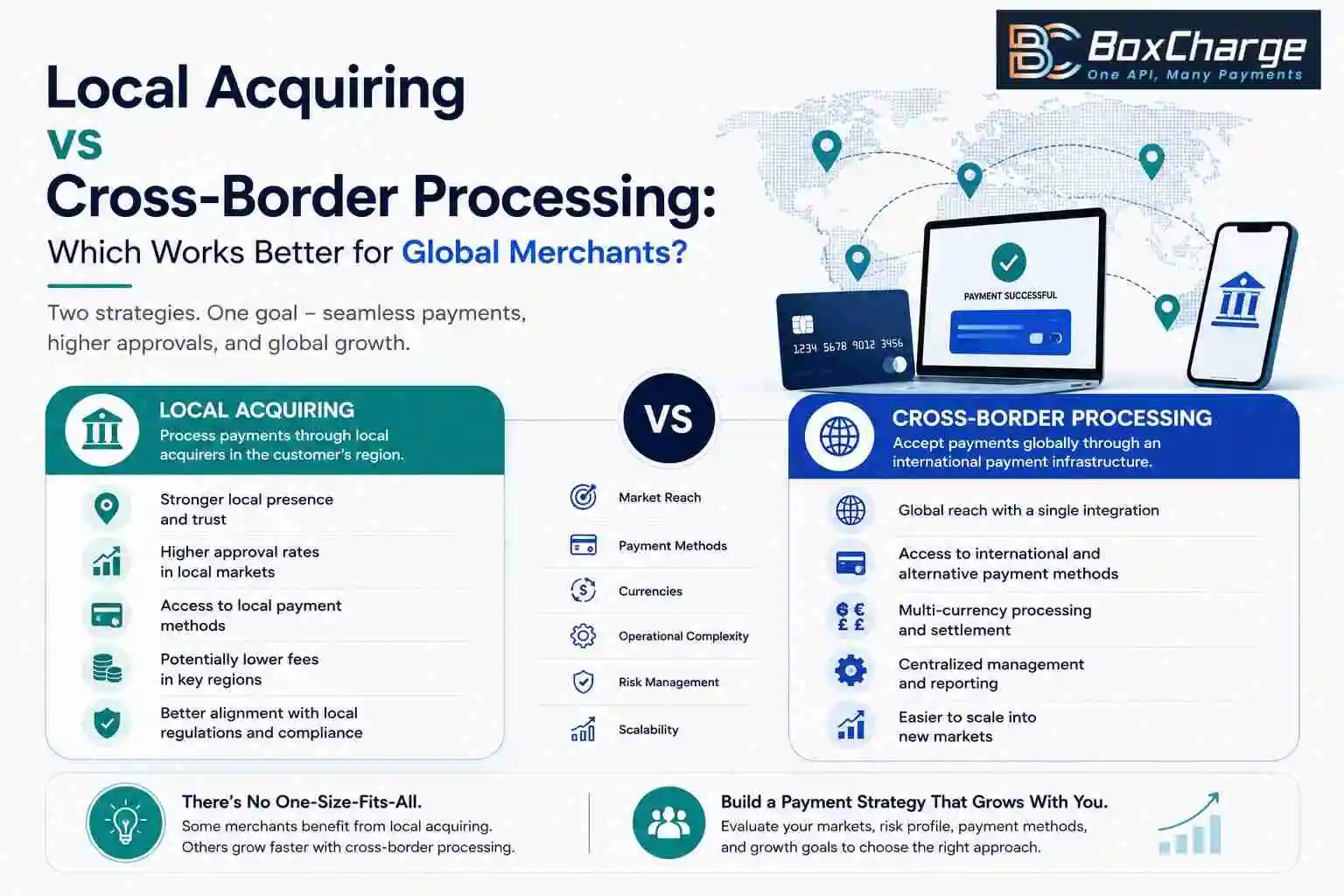
Local acquiring means using an acquiring bank or payment partner that operates within, or has a strong connection to, the market where the customer and transaction are located.
The basic idea is straightforward.
A customer in Germany, for example, may be more likely to complete a transaction when the payment is processed through infrastructure familiar to the local banking ecosystem and when the checkout supports commonly used local payment methods.
The same principle applies across other markets.
A merchant selling into the UK may want access to UK payment rails and customer preferences. A business targeting Australia may need payment options and acquiring relationships suited to Australian buyers. A company expanding across Europe may need support for regional payment methods rather than relying entirely on international cards.
Local acquiring can potentially provide:
Better alignment with local payment behaviour
Access to regional payment methods
Reduced cross-border transaction friction
Local currency processing or settlement options
Potentially stronger authorization performance
A more familiar customer checkout experience
The important word is potentially. Local acquiring does not automatically guarantee higher approval rates or lower costs. The merchant's industry, MCC, transaction profile, fraud levels, acquiring relationship, and underwriting terms still matter.
What Is Cross-Border Payment Processing?
Cross-border payment processing allows a merchant to accept payments from customers in different countries without necessarily establishing a separate domestic acquiring arrangement in every market.
Instead of building multiple disconnected payment systems, merchants can use international payment infrastructure that connects to acquiring partners, card networks, alternative payment methods, and multiple currencies.
This can be particularly attractive for digital businesses.
Imagine a UK SaaS company selling subscriptions to customers in 20 countries. Establishing an independent payment infrastructure in every market would introduce additional integrations, compliance processes, reconciliation work, and operational overhead.
A well-designed international payment gateway can consolidate much of that complexity.
Modern cross-border infrastructure may include:
Multi-currency payment processing
International card acceptance
Local and regional alternative payment methods
3DS authentication
Tokenization
Smart payment routing
Multiple acquiring connections
Centralized reporting
Unified reconciliation
Hosted checkout and API integrations
BIS research published in 2026 also highlights interoperability, standardized APIs, expanded access to payment systems, and harmonized ISO 20022 data as important elements in improving cross-border payment services.
That direction is significant because the future of international payments is increasingly about connecting different payment ecosystems rather than forcing merchants to operate completely separate systems.
Local Acquiring vs Cross-Border Processing
The simplest way to think about the two models is this:
Local acquiring prioritizes market-level payment optimization. Cross-border processing prioritizes international flexibility and centralized management.
A global merchant may ultimately need both.
Factor | Local Acquiring | Cross-Border Processing |
Market expansion | Strong for established markets | Strong for testing multiple markets |
Local payment methods | Often stronger | Depends on gateway/partner coverage |
Multi-currency | Market-dependent | Usually a core capability |
Infrastructure | More localized | More centralized |
Operational complexity | Can increase across countries | Can be lower with one integration |
Scalability | Strong within specific markets | Strong across multiple regions |
Acquiring relationships | Local/regional | International/multi-acquirer |
Best suited for | High-volume priority markets | International and rapidly expanding merchants |
The decision should therefore be based on the merchant's commercial strategy, not simply on which model sounds more advanced.
Why High-Risk Merchants Face a Different Decision
The acquiring decision becomes more complicated for high-risk merchants.
A conventional e-commerce business might be able to obtain a standard merchant account and begin processing relatively quickly. High-risk merchants can face a much more difficult path.
Businesses in sectors such as forex, gaming, gambling, nutraceuticals, subscriptions, digital services, travel, marketplaces, and other specialist industries may encounter:
Higher underwriting scrutiny
Merchant account application rejections
Rolling reserves
Higher processing costs
Transaction or volume restrictions
Increased chargeback monitoring
Fraud-related declines
Delayed settlements
Sudden reviews of transaction activity
Limited access to acquiring partners
For these merchants, moving into another country does not necessarily mean simply adding another currency.
The risk profile travels with the transaction.
A high-risk merchant might have excellent customer demand but still experience payment friction because an issuer sees an international transaction, an unusual transaction pattern, or a merchant category associated with higher dispute or fraud exposure.
This is where payment orchestration and multi-acquirer connectivity can become commercially valuable.
Local Acquiring Can Reduce Some Payment Friction
One of the strongest arguments for local acquiring is that it can make the payment experience feel more native to the customer.
Consider an online retailer entering France.
The business can advertise in French, display prices in euros, provide local customer support, and ship domestically. But if the checkout only presents unfamiliar payment options or routes every transaction through an overseas processing setup, the payment experience can still feel foreign.
The ECB continues to identify cross-border payments as an area where cost, complexity, speed, and accessibility need improvement. Its retail payments strategy also emphasizes pan-European payment solutions, instant payments, resilience, and improved cross-border payment capabilities.
For merchants, this reinforces an important point: localization does not stop at the website. It extends to the payment experience.
Cross-Border Processing Can Be Better for Fast International Expansion
Local acquiring becomes more attractive when a market reaches meaningful transaction volume.
But what happens when a merchant is still testing ten markets?
Creating separate acquiring relationships for each country can become expensive and operationally difficult.
A centralized cross-border payment processing setup can allow the merchant to launch internationally with fewer technical dependencies while gathering real transaction data.
This is particularly useful for:
SaaS businesses
Digital services
International e-commerce
Subscription businesses
Online marketplaces
Travel businesses
Global platforms
High-risk merchants serving multiple jurisdictions
Instead of making a large infrastructure investment before knowing whether a market will work, the merchant can establish international acceptance first and optimize individual markets as transaction volume develops.
That creates a more practical growth path.
Payment Routing Matters More Than Many Merchants Realize
The acquiring decision should also include smart payment routing.
A merchant may have multiple acquiring relationships but still perform poorly if every transaction follows the same route.
Payment orchestration can allow eligible transactions to be directed through different acquiring connections or processing paths based on factors such as geography, currency, payment method, or transaction performance.
BoxCharge positions its payment infrastructure around smart routing, cascading payments, multi-acquirer connectivity, 3DS authentication, tokenization, fraud prevention, and centralized payment visibility.
Its cross-border gateway also combines card and alternative payment method connectivity with multi-currency presentment, routing, authentication, tokenization, and reporting.
For a merchant processing meaningful international volume, this can be more valuable than simply having access to another payment gateway.
The Hidden Cost of Choosing the Wrong Model
The biggest payment cost is not always the processing fee.
A merchant can negotiate an attractive rate and still lose money through:
Failed transactions
Cart abandonment
Poor authorization rates
Currency conversion friction
Excessive chargebacks
Settlement delays
Manual reconciliation
Payment downtime
Customer support issues
For high-risk businesses, these costs can become even more painful.
Imagine a gaming merchant spending heavily to acquire new customers in a European market. The marketing campaign works. Traffic increases. Customers reach checkout. But a significant percentage of legitimate transactions fail because the merchant's payment setup is poorly aligned with local payment behaviour.
The merchant has paid for the customer acquisition but cannot monetize the demand efficiently.
That is a payment infrastructure problem, not a marketing problem.
How Should Global Merchants Choose?
Before selecting between local acquiring and cross-border processing, merchants should examine five areas.
Q. Where Are Your Customers?
If most revenue comes from two or three markets, local acquiring may deserve serious consideration.
If customers are spread across dozens of countries, centralized cross-border infrastructure may be more practical.
Q. What Payment Methods Do Customers Prefer?
Cards remain important, but local wallets, bank payments, account-to-account methods, and other alternative payment methods can influence conversion.
A global checkout should reflect the payment habits of the markets being targeted.
Q. How Risky Is the Business Model?
A high-risk merchant needs to look beyond payment acceptance.
Underwriting, fraud prevention, chargeback management, reserves, settlement terms, and acquiring relationships should all be evaluated before selecting a provider.
Q. How Quickly Are You Expanding?
A business entering one new market every few years may have time to develop local acquiring relationships.
A business entering ten markets in twelve months needs a much more scalable infrastructure model.
Q. What Happens When Transaction Volume Increases?
This question is frequently overlooked.
A payment setup that works at £50,000 per month may become inefficient at £500,000. Merchants should understand what happens to pricing, reserves, acquiring capacity, fraud monitoring, settlement, and routing as volume increases.
The Best Strategy May Be a Hybrid Model
For many global merchants, the answer is not local acquiring or cross-border processing.
It is both.
A merchant can use centralized cross-border infrastructure to enter new markets while developing local acquiring arrangements in its highest-volume regions.
This creates a more flexible payment architecture.
For example, a business might use international processing while testing demand in Spain, Italy, and Australia. Once one market becomes strategically important, it can explore local acquiring to optimize the payment experience and economics there.
This hybrid approach is particularly relevant for high-risk businesses because it reduces dependence on a single processing relationship.
Build a Payment Strategy Around Where Your Business Is Going
The global payments industry is moving toward greater interoperability, standardized data, APIs, faster payment connections, and more connected payment infrastructure. BIS has identified interoperability and harmonized standards as important priorities for improving cross-border payments.
That means merchants should stop thinking about payment processing as simply a gateway connected to a website.
The more useful question is:
Can the payment infrastructure support the markets, customers, risk profile, currencies, and transaction volumes the business expects to handle over the next few years?
For some merchants, the answer will be local acquiring. For others, it will be a centralized international payment gateway. For growing global businesses, a combination of local acquiring, cross-border processing, alternative payment methods, and payment orchestration may provide the strongest foundation.
Looking for a Global Payment Setup Built Around Your Business?
If your business is dealing with international customers, multiple currencies, high-risk underwriting, payment declines, or fragmented acquiring relationships, it may be time to review the payment infrastructure behind your checkout.
BoxCharge provides global merchant services, cross-border payment gateway connectivity, multi-currency processing, alternative payment method access, and payment orchestration through partner-led acquiring relationships. Its global merchant service is designed to coordinate merchant onboarding, risk review, acquiring connectivity, currencies, and reporting across international markets.
For merchants evaluating local acquiring vs cross-border payment processing, the right starting point is not simply asking which option is cheaper. It is understanding which structure can provide reliable payment acceptance, manageable risk, efficient settlement, and room to scale.
Speak with BoxCharge about building a payment setup aligned with your target markets, transaction profile, and international growth plans.