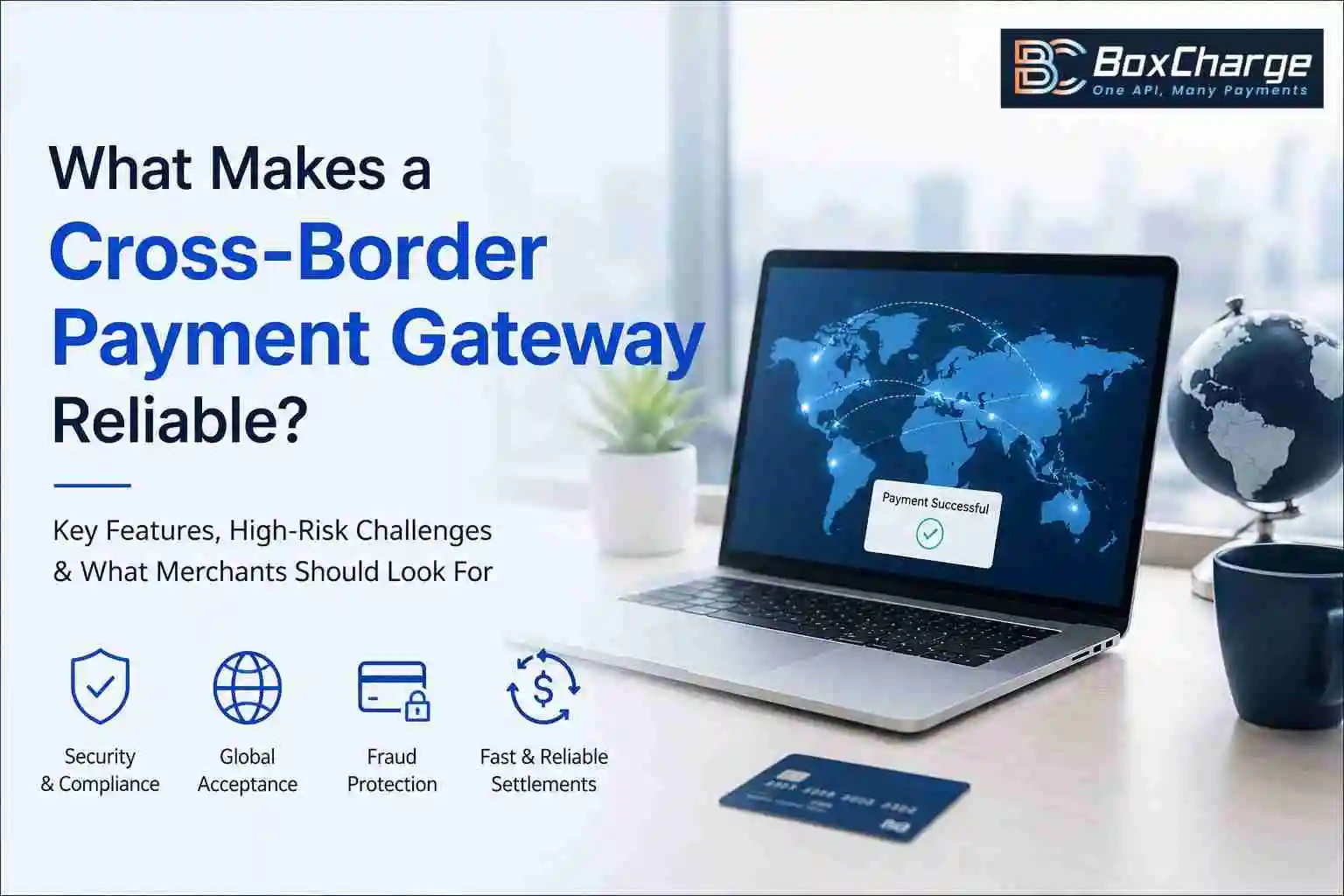
What Makes a Cross-Border Payment Gateway Reliable? Expanding into international markets sounds straightforward until payments become the bottleneck. A customer in one country wants to pay with a local card, another prefers an alternative payment method, and the merchant needs to settle funds in a different currency. When the payment gateway cannot handle those moving parts reliably, international growth quickly turns into declined transactions, delayed settlements, unexpected fees, and frustrated customers.
For high-risk businesses, the challenge is even greater. Merchants operating in industries such as online gaming, forex, digital assets, adult services, nutraceuticals, travel, and other regulated or higher-chargeback sectors often face stricter underwriting, limited banking options, rolling reserves, and sudden processing interruptions.
That is why choosing a reliable international payment gateway is not simply about finding a way to accept cards overseas. It is about building a payment infrastructure capable of supporting customers, currencies, compliance requirements, fraud controls, and settlement needs across multiple markets.
Google's current guidance also emphasizes helpful, reliable, people-first content that demonstrates genuine expertise rather than content created primarily to manipulate rankings.
What Is a Cross-Border Payment Gateway?
A cross-border payment gateway enables businesses to accept payments from customers in different countries and currencies while connecting the transaction with the appropriate acquiring, processing, fraud, authentication, and settlement infrastructure.
A basic domestic gateway may be sufficient when a business serves customers in one market. International merchants, however, often need much more.
A dependable gateway may need to support:
Multiple currencies
International card acceptance
Local and alternative payment methods
Multi-currency settlement
3D Secure authentication
Fraud screening
Chargeback management
Currency conversion
Regulatory and KYC requirements
Multiple acquiring connections
International settlement options
This is where cross-border payment gateway solutions become strategically important. The gateway is no longer just a checkout tool. It becomes part of the merchant's overall revenue infrastructure.
Why Cross-Border Payments Are Difficult for High-Risk Merchants
The payment problems faced by high-risk merchants are rarely limited to payment acceptance.
A merchant may have a perfectly functional website, strong customer demand, and legitimate transactions but still struggle to secure stable processing.
One of the biggest frustrations is inconsistency.
A merchant might receive approval from a processor and spend weeks integrating the payment system, only to discover that certain countries, products, transaction sizes, or customer profiles are restricted. In other situations, processing works well initially but becomes difficult when transaction volume increases.
High-risk merchants can also encounter:
Higher underwriting requirements: Payment providers may request detailed information about ownership, business operations, expected processing volumes, customer acquisition channels, refund policies, and transaction history.
Higher chargeback exposure: Cross-border transactions can create additional disputes because customers may be unfamiliar with the merchant, currency conversion, billing descriptors, or refund process.
Settlement delays: International transactions can involve multiple financial institutions, currencies, and compliance checks, increasing operational complexity.
Limited acquiring access: Some traditional providers are reluctant to support businesses considered high risk, leaving merchants with fewer acquiring options.
Reserve requirements: Depending on the risk profile, a processor may require reserves or other financial protections.
Sudden account disruption: A merchant that depends on a single processing relationship can face serious cash-flow problems if that relationship is terminated or restricted.
For these businesses, the question is not simply, "Can this gateway process international cards?"
The better question is: Can this payment infrastructure continue processing when the business grows, expands geographically, and encounters higher transaction risk?
7 Features That Make a Cross-Border Payment Gateway Reliable
1. Multi-Currency Payment Acceptance
A global customer should not necessarily have to pay in the merchant's domestic currency.
Supporting major currencies can reduce friction at checkout and give international customers a more familiar payment experience. A gateway should clearly explain how currency conversion, authorization, settlement, and foreign-exchange costs are handled.
For businesses selling internationally, multi-currency capability is one of the foundations of effective global payment processing.
2. Multiple Acquiring and Processing Connections
Relying on one processing route can create unnecessary concentration risk.
A reliable gateway can provide access to multiple acquiring or processing relationships where appropriate. This can improve payment routing and give merchants greater flexibility when entering new markets.
For high-risk merchants, this is particularly valuable because availability can vary by industry, geography, transaction type, and customer location.
The goal is not simply to have more processors. It is to have an infrastructure strategy that can support continuity as the merchant's requirements change.
3. Strong Fraud and Risk Management
International payments naturally create additional variables.
A transaction may originate from one country, use a card issued in another, involve a customer located elsewhere, and settle in yet another currency. That complexity can make fraud detection more challenging.
A reliable gateway should therefore support risk controls such as:
Transaction monitoring
Velocity checks
Device and behavioral signals
3D Secure authentication
Geographic controls
Rule-based screening
Suspicious transaction monitoring
Chargeback alerts and management
The objective is balance. Overly aggressive fraud controls can decline legitimate customers, while weak controls can increase fraud and chargebacks.
The best international payment processing services aim to protect merchants without unnecessarily damaging conversion rates.
4. Local Payment Methods
Cards remain important, but international customers increasingly expect payment options that are familiar in their own markets.
Depending on the target geography, this could include bank transfers, digital wallets, account-based payments, and other alternative payment methods.
For an international ecommerce payment gateway, supporting relevant local payment methods can make the checkout experience feel considerably more native.
A merchant selling into several countries should therefore ask not only which cards are accepted, but also:
Which payment methods do customers in our target markets actually prefer?
That question can have a direct impact on checkout conversion.
5. Transparent Settlement and Payouts
Successful authorization does not mean the merchant has successfully received its money.
Settlement is a critical part of international payment infrastructure.
Before choosing a provider, merchants should understand:
Settlement currencies
Settlement timelines
Minimum payout thresholds
Conversion fees
Reserve requirements
Refund procedures
Chargeback deductions
International transfer costs
This is especially important for high-risk businesses managing large transaction volumes. A gateway that accepts payments efficiently but creates unpredictable settlement conditions may create serious cash-flow pressure.
Reliable global merchant payment services should provide merchants with a clear understanding of where funds move and when they become available.
6. Compliance and Merchant Underwriting
Cross-border payment processing cannot be separated from compliance.
Payment providers need to understand the merchant, its customers, products, jurisdictions, transaction patterns, and risk exposure. Depending on the business model and markets involved, this can include KYC, KYB, AML controls, sanctions screening, transaction monitoring, and other regulatory requirements.
High-risk merchants should be particularly careful with providers promising "instant approval" without clearly explaining underwriting.
A legitimate payment relationship requires transparency from both sides.
Businesses exploring international merchant account providers should ask what information is required during underwriting, which markets are supported, what restrictions apply, and how ongoing compliance reviews are handled.
7. Scalability for Growing Transaction Volumes
A payment gateway that works for 500 transactions per month may not perform the same way when the merchant reaches 50,000.
International growth introduces additional complexity:
More currencies
More customers
More payment methods
More fraud patterns
More regulatory considerations
Higher transaction values
Increased chargeback exposure
Greater settlement requirements
Reliable international online payment solutions should therefore be designed around scalability rather than simply today's processing volume.
Offshore High-Risk Merchant Accounts: What Merchants Should Consider
For some businesses, traditional domestic acquiring may not provide the flexibility they need. This is one reason merchants investigate offshore high-risk merchant accounts and international acquiring structures.
However, offshore should not automatically mean better.
The important considerations are the quality of the acquiring relationship, regulatory framework, supported markets, settlement terms, risk controls, transparency, and long-term processing stability.
Merchants should avoid providers that make unrealistic promises about guaranteed approvals, zero chargebacks, unrestricted processing, or completely risk-free international acceptance.
A strong provider will explain the risks instead of pretending they do not exist.
How Reliable Payment Infrastructure Helps High-Risk Merchants
For high-risk businesses, payment processing should be viewed as a business continuity function.
Imagine an online merchant spending heavily on advertising and successfully attracting customers from several countries. Suddenly, the processor limits transactions from one market. Customers begin seeing failed payments. Support tickets increase. Revenue falls. The marketing campaign continues spending money, but the checkout cannot reliably convert that traffic.
That is not merely a payment problem.
It becomes a customer acquisition problem, cash-flow problem, and revenue problem.
This is why best cross-border payment gateway solutions should be evaluated according to their ability to support the entire payment lifecycle—not just authorization.
A reliable infrastructure can help merchants build a more resilient payment operation through appropriate acquiring relationships, payment routing, risk controls, multiple payment methods, and transparent settlement.
How to Evaluate an International Payment Gateway
Before signing an agreement, merchants should look beyond advertised processing rates.
Ask practical questions:
Q. Which countries can you process?
Geographic coverage should be clear rather than based on vague claims about "global acceptance."
Q. Which currencies and payment methods are supported?
A gateway should align with the markets where the merchant actually operates.
Q. How are high-risk businesses underwritten?
Merchants should understand eligibility, documentation, restrictions, reserves, and monitoring.
Q. What happens when transaction volume increases?
Scaling should not unexpectedly trigger processing restrictions.
Q. How are chargebacks handled?
Understand dispute workflows, fees, alerts, representment, and liability.
Q. How quickly are funds settled?
Settlement timing can have a major impact on working capital.
Q. What happens if a processing route becomes unavailable?
Redundancy and routing options can be important for businesses that cannot afford prolonged interruptions.
These questions help separate a genuine payment infrastructure provider from a company focused primarily on selling a low headline rate.
Why the Cheapest Gateway Is Not Always the Best
Payment processing costs matter, but price should never be the only selection criterion.
A gateway with slightly lower transaction fees can become significantly more expensive if it produces higher decline rates, poor authorization performance, delayed settlements, weak fraud controls, or frequent account interruptions.
For international merchants, the more useful metric is the overall economics of payment acceptance.
That includes:
Authorization rate + conversion + settlement reliability + fraud control + operational support + total processing cost.
This is particularly relevant for high-risk merchants, where payment stability can be more valuable than a marginal difference in processing fees.
Building a More Resilient Cross-Border Payment Strategy
The modern international merchant needs more than a payment button.
A strong payment strategy connects acquiring, payment processing, risk management, currencies, settlement, and customer experience into one coordinated system.
That is the role of global payment processing.
For merchants entering new markets, the process should begin with understanding customer payment preferences and regulatory requirements. From there, businesses can evaluate acquiring options, payment methods, fraud controls, settlement structures, and scalability.
This approach is more sustainable than selecting a provider solely because it advertises itself as a "global payment gateway."
Final Thoughts
A reliable cross-border payment gateway is measured by what happens beyond the successful checkout.
Can it support international customers? Can it handle multiple currencies? Can it manage fraud and chargebacks? Can it provide predictable settlement? Can it accommodate high-risk merchants responsibly? Can the infrastructure scale when transaction volumes grow?
Those are the questions that matter.
For businesses seeking international payment gateway infrastructure, the right solution should fit the merchant's industry, target markets, transaction profile, risk requirements, and growth strategy.
At BoxCharge, the focus is on helping businesses evaluate payment infrastructure around real operational requirements—not simply headline processing rates. Whether a merchant needs global merchant payment services, cross-border payment gateway solutions, or specialized support for higher-risk processing, the objective should always be the same: to build a payment setup that supports sustainable international growth.
If your existing payment setup is resulting in declined transactions, settlement delays, geographic restrictions, or unnecessary friction for international customers, it may be time to review your processing infrastructure and explore a more suitable international payment strategy.
Speak with BoxCharge to discuss your business model, target markets, processing requirements, and international payment needs.