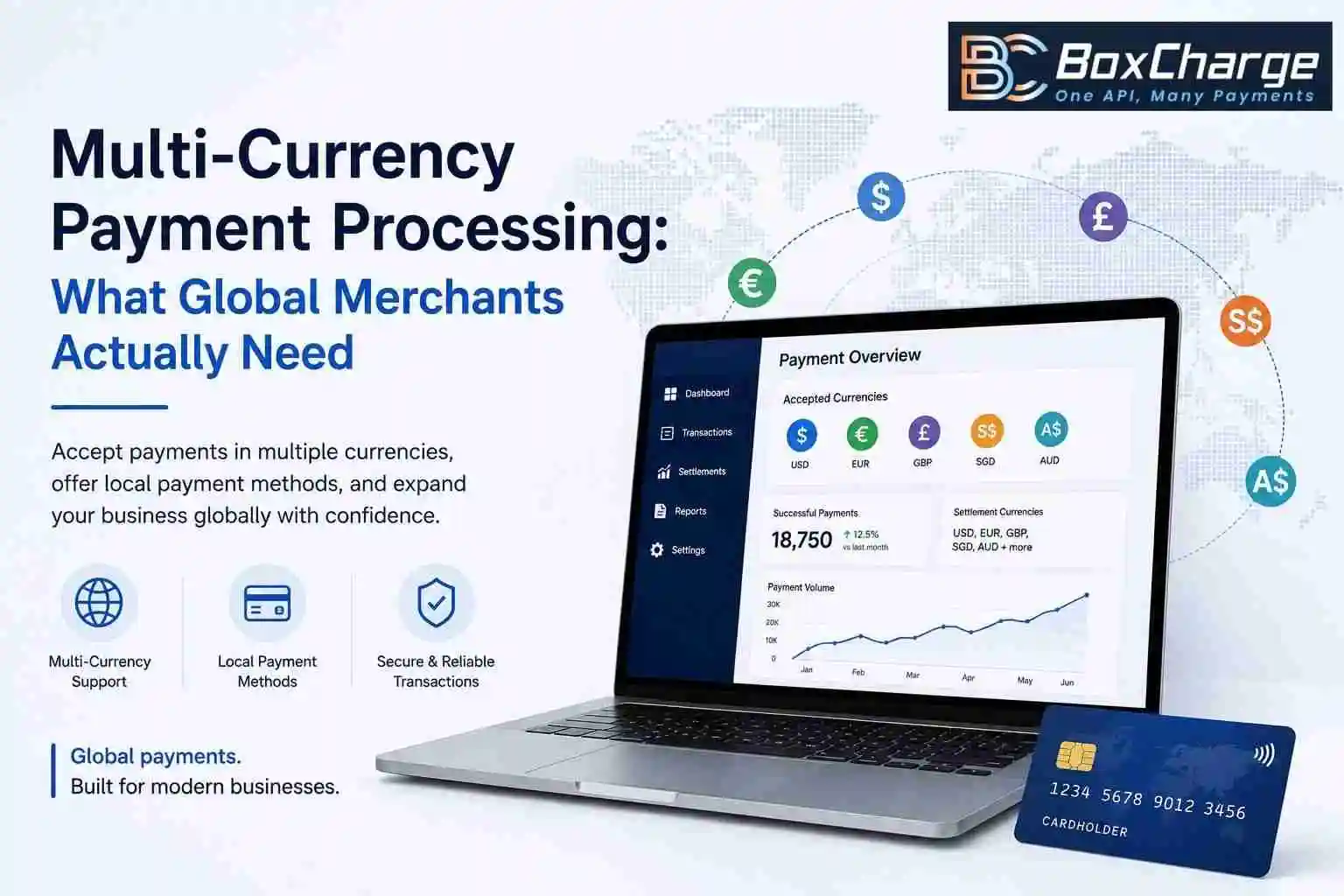
Multi-currency payment processing is no longer just a feature for large multinational companies. For ecommerce brands, SaaS companies, travel businesses, marketplaces, digital platforms, and high-risk merchants, accepting customers in their preferred currencies can directly affect checkout confidence, payment approval, cash flow, and international growth.
A customer in the UK may expect to see GBP. A buyer in Germany may prefer EUR. A U.S. customer expects USD, while an Australian customer may be more comfortable paying in AUD. Giving every customer the same currency and payment experience can create unnecessary friction at the final stage of a sale.
The challenge is that accepting multiple currencies involves considerably more than displaying different currency symbols on a checkout page. Merchants need to think about multi-currency payment gateways, acquiring coverage, foreign exchange, settlement, local payment methods, fraud prevention, reconciliation, and compliance.
The complexity increases further for high-risk businesses, which can already face higher processing costs, rolling reserves, additional underwriting, chargeback monitoring, and fewer banking options.
Why Multi-Currency Payment Processing Matters for Global Merchants
International expansion changes the payment equation.
A business can attract visitors from dozens of countries through search, advertising, affiliates, social media, and marketplaces. But generating international traffic does not automatically mean those customers will complete a purchase.
Currency is one of the simplest points of friction to address.
When customers see a familiar currency at checkout, they have a clearer understanding of the purchase amount. They do not have to estimate exchange rates or wonder whether their bank will apply additional conversion charges.
This is particularly relevant as cross-border commerce becomes more sophisticated. The Bank for International Settlements (BIS) notes that cross-border payments remain more costly, slower, less accessible, and less transparent than domestic payments, with interoperability and differences between countries continuing to create friction.
For merchants, that means the payment layer deserves as much attention as the storefront, logistics, and customer acquisition strategy.
A Multi-Currency Payment Gateway Does More Than Convert Prices
A multi-currency payment gateway should not be confused with a simple currency converter.
A currency converter changes the displayed price.
A payment gateway needs to help process the actual transaction.
Depending on the provider and merchant setup, a global payment infrastructure can support:
Multi-currency checkout and presentment
Card payments across different regions
Local and alternative payment methods
Currency conversion and FX handling
Multi-currency settlement
Transaction routing
3D Secure authentication
Tokenization
Fraud monitoring
Reporting and reconciliation
This distinction matters because a merchant can display EUR to a customer while still processing the underlying transaction through infrastructure that was designed primarily for another market.
BoxCharge's global merchant services, for example, are designed around international acquiring connectivity, multi-currency processing, local payment methods, reporting, and risk-aware onboarding.
The objective is to create a payment environment where the customer experience and the merchant's back-office requirements work together.
Local Currency Is Only One Part of Payment Localization
A common mistake is to assume that supporting local currencies automatically creates a localized checkout.
It does not.
Customers also have local payment preferences.
Worldpay's Global Payments Report shows how payment behavior differs significantly by region. Digital wallets are the leading online payment method in many Asia-Pacific markets, while European consumers also show strong adoption of digital wallets and account-based payment methods.
For a global merchant, that means the payment strategy should consider both currency and payment method.
For example, a business targeting Europe may need to think beyond cards. A merchant targeting Asia-Pacific may need regional wallets or alternative payment methods. A company selling across North America may prioritize cards and digital wallets differently.
The right combination depends on the countries, customer demographics, transaction values, and business model.
High-Risk Merchants Face a Harder Payment Challenge
For high-risk merchants, international payment processing can become considerably more complicated.
Consider a subscription business that starts with customers primarily in the UK. Its payment setup may work reasonably well at first. Then the company expands into Europe, North America, and Australia.
Transaction volumes rise.
Currencies multiply.
Chargebacks increase.
The acquiring partner begins reviewing the merchant's activity more closely.
Suddenly, the business is dealing with rolling reserves, settlement delays, additional documentation requests, or processing restrictions.
This is not necessarily because the business has done something wrong. High-risk merchants can receive additional scrutiny because of their industry, customer geography, recurring billing model, transaction patterns, or chargeback exposure.
The problem is that payment infrastructure is often built reactively.
A merchant chooses a processor because it solves today's problem, only to discover that it cannot comfortably handle tomorrow's volume.
That is why high-risk payment processing should be evaluated as long-term infrastructure rather than simply a way to obtain a merchant account.
Foreign Exchange Can Affect the Real Cost of Payments
Multi-currency acceptance introduces another consideration: foreign exchange.
A merchant may accept EUR, USD, GBP, CAD, AUD, and other currencies, but those funds eventually need to be settled, converted, or used to pay suppliers and operating expenses.
FX costs can therefore become an important part of the payment economics.
The BIS has identified foreign exchange conversion as a significant contributor to cross-border payment costs, citing factors including limited liquidity in some local-currency markets, market concentration, and limited pricing transparency.
Merchants should therefore ask a payment provider:
What happens after the transaction is approved?
That question can reveal more than the headline processing rate.
Businesses should understand:
Which currencies can be accepted
Which currencies can be settled
Where conversion takes place
How FX rates are determined
What conversion spread applies
Whether balances can be maintained in multiple currencies
How refunds are handled
How reconciliation works across currencies
A payment solution can have attractive transaction pricing but still become expensive if FX and settlement costs are poorly managed.
Multi-Currency Settlement Can Improve Cash-Flow Management
Multi-currency settlement can be particularly valuable for businesses with international operating expenses.
Imagine a merchant receiving EUR from European customers, GBP from the UK, and USD from American customers.
If every transaction is automatically converted into one base currency, the business may incur repeated FX conversions.
Where available and appropriate, maintaining balances or settling in supported currencies can give merchants greater control over when and how conversions occur.
This can also make reconciliation easier when revenue and expenses are naturally denominated in different currencies.
However, settlement options depend on the provider, acquiring relationships, jurisdiction, banking arrangements, and merchant profile. They should therefore be evaluated during onboarding rather than assumed.
Payment Methods Matter Just as Much as Currencies
A global merchant can support ten currencies and still lose sales if the checkout does not provide payment methods customers trust.
This is where local payment methods for international businesses become important.
BoxCharge's cross-border gateway infrastructure combines multi-currency presentment with card acceptance, alternative payment method connectivity, 3DS, tokenization, routing, and unified reporting.
The broader payments market is also moving toward greater interoperability. BIS research published in 2026 highlights expanded access to payment systems, interoperability, instant payment links, standardized APIs, and harmonized ISO 20022 requirements as important components of better cross-border payment infrastructure.
For merchants, the practical takeaway is simple: international payment infrastructure is becoming more connected, but the underlying complexity has not disappeared.
Someone still has to manage the connections.
Payment Routing Can Make a Difference
A merchant processing internationally does not necessarily have to send every transaction through the same acquiring route.
Payment orchestration and intelligent routing can connect merchants to multiple acquiring relationships and route eligible transactions according to factors such as region, currency, payment method, or performance.
This can become particularly useful for high-risk merchants.
If one acquirer has weaker performance in a particular corridor, routing infrastructure may allow eligible transactions to use another available route.
BoxCharge describes its payment orchestration capabilities as using multi-acquirer connectivity, cascading logic, and performance-aware routing.
The purpose is not to bypass legitimate risk controls.
It is to avoid making the entire payment operation dependent on a single route when a merchant's business genuinely requires broader acquiring coverage.
Fraud Prevention Cannot Be an Afterthought
International payments naturally create additional risk signals.
A transaction may involve:
A customer in one country
A card issued in another
A merchant registered somewhere else
A billing address in a fourth jurisdiction
A currency different from the merchant's domestic currency
These transactions are not automatically fraudulent, but they can require more sophisticated risk analysis.
Payment fraud prevention tools such as 3D Secure, tokenization, transaction monitoring, velocity rules, device intelligence, and risk scoring can help merchants distinguish legitimate international customers from suspicious activity.
BoxCharge's payment technology layer includes 3DS authentication, tokenization, fraud rules, velocity controls, and transaction monitoring.
For high-risk merchants, this is especially important because excessive fraud and chargebacks can put additional pressure on acquiring relationships.
The objective should be to reduce fraudulent activity without creating so much checkout friction that legitimate customers abandon their purchases.
Reconciliation Becomes More Important as Currencies Multiply
One issue that merchants sometimes underestimate is accounting.
Processing in one currency is relatively straightforward.
Processing in ten currencies across multiple payment methods, acquirers, settlement accounts, and countries is another matter entirely.
Finance teams need to understand:
Gross transaction value
Processing fees
FX conversions
Refunds
Chargebacks
Reserves
Net settlement
Settlement currency
Settlement date
Without centralized reporting, teams can end up reconciling multiple provider dashboards and bank statements manually.
For international merchants, multi-currency payment processing should therefore be evaluated alongside reporting and reconciliation capabilities.
A sophisticated payment setup should reduce operational complexity rather than simply move it somewhere else.
What Global Merchants Should Look for in 2026
Before selecting a global payment processing solution, merchants should look beyond the number of currencies advertised on a provider's website.
A stronger evaluation checklist includes:
1: Currency coverage: Can the provider support the currencies customers actually use?
2: Payment-method coverage: Does it support cards, wallets, bank methods, and relevant regional APMs?
3: Acquiring coverage: Can the merchant access suitable acquiring relationships across its target markets?
4: Settlement: Can funds be settled in useful currencies and timeframes?
5: FX: Are conversion rates and fees transparent?
6: Security: Are 3DS, tokenization, fraud monitoring, and other controls available?
7: Scalability: Can the infrastructure handle increased transaction volume?
8: Reporting: Can finance teams reconcile transactions across currencies and payment methods?
9: Risk management: Does the provider understand the merchant's industry and risk profile?
10: Integration: Can the solution connect through hosted checkout, APIs, webhooks, or other appropriate methods?
These questions are more useful than simply asking, "What is your processing rate?"
The Right Multi-Currency Strategy Is Built Around the Business
There is no single multi-currency setup that works for every global merchant.
A European SaaS company may need strong EUR and GBP capabilities. A U.S. ecommerce brand expanding into Asia may prioritize regional wallets and local currencies. A travel company may need broad currency coverage because customers come from many countries. A high-risk merchant may place greater emphasis on acquiring diversification, fraud controls, chargeback management, and stable settlement.
That is why payment infrastructure should be designed around actual payment corridors rather than a generic global checklist.
BoxCharge's global merchant services combine international merchant enablement, multi-currency acquiring, local payment connectivity, reporting, risk-aware onboarding, and payment technology such as smart routing and tokenization.
Build Payment Infrastructure for Global Growth
Multi-currency payment processing can help global merchants create a more familiar checkout experience, but currency support alone is not enough.
The strongest international payment setups combine local payment methods, suitable acquiring relationships, transparent FX, multi-currency settlement, fraud prevention, payment orchestration, and reliable reporting.
For high-risk businesses, the need is even greater. Payment interruptions, rolling reserves, chargebacks, account reviews, and limited acquiring options can quickly turn payment processing into a growth constraint.
Global merchants should therefore treat payment infrastructure as a strategic part of expansion—not an afterthought added after entering a new market.
As cross-border payment systems continue moving toward greater interoperability and faster settlement, businesses that build flexible payment infrastructure today will be better positioned to serve customers across currencies and markets tomorrow.
For merchants evaluating multi-currency payment processing, the right question is not simply how many currencies a provider can accept. It is whether the entire payment stack can reliably support where the business is today—and where it plans to grow next.